

SPOOKIES
The FINAL Director's War Story

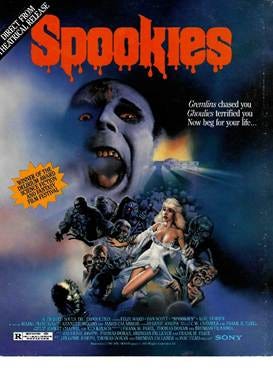
Where shall I begin the Truly Twisted Tale of SPOOKIES – the film that came back from the dead? SPOOKIES went on to win several awards at the International Festival of Science Fiction and Fantasy Films in Paris, France, in 1986. But it almost didn’t see the light of day.
In 1985, I was hired to “save” this low-budget horror film. Even now, fan mail for this cult classic still creeps into my inbox. But what truly sets "SPOOKIES" apart is its "behind the scenes saga" – a tale as twisted as the monsters and creatures that haunted our sets.
Imagine a production where three writer-directors were axed before I reluctantly took the reins. I'm sure you can imagine their hard feelings. They hate me!
I still have dreams about those creep-aliscious monsters swarming through celluloid! Nothing at New York University Film School prepared me for this. They didn’t have classes in rescuing films on life support – although I have since learned that this happens more than anyone knows. Film Doctors are specialists who are highly paid to re-edit, re-write, and re-shoot parts of films to make them releasable.
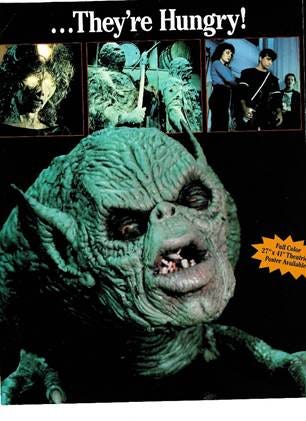
It's hard enough to make any feature film, much less one for half a million dollars. That's what some Hollywood movies spend on snacks. So before you judge this cult-classic, gothic horror spoof too harshly, bear in mind our low budget was so low my mother had to make me lunch.
Here's what happened: three directors before me (Thomas Doran, Brendan Faulkner, Frank Farel) were fired by the producer, Michael Lee, a charming Englishman and master chess player. I never met the fired trio. They hate me!
When I first met the producer, he said he needed an editor and showed me the rough cut. I was horrified. It was a behemoth of chaos – three hours of crazy, rambling, out-of-control celluloid. Although I needed a job, I did everything I could NOT to get hired. I told the producer point-blank the problems with the structure, content, and chances of this film ever seeing the light of day. I figured that was enough to disqualify me for the job. Instead, he said he agreed with me; he knew he couldn't sell this film in its current form.
I said I would take the editing job (paying $500 a week) on one condition: he let me cut everything I didn't think was working. Then, we would discuss what we would need to re-shoot. He hired me on the spot, which was good because I wouldn't have taken the job if I had two minutes to think about it.
Any film that is three hours long is an editorial emergency. It would require some ruthless slicing and dicing with an editorial knife. I slashed away until all that was left was the pure essence: special effects, grotesque monsters, and gallons of gory goo. The result? It was a lean, mean horror machine – with no plot – that clocked in at almost 40 minutes.
But half a movie wasn't going to scare anyone. Except the investors who were panicked. So, like any film on life support, we did what needed to be done. We had to shoot an additional 45 minutes. The problem was that the fired directors had used all their friends as actors, and none of them would work with us to get the film finished.
So now I had to write a new script – that would use the old characters and usable monster footage – plus create a new storyline, with new actors and new characters. Then, it would need to be woven together to make it look like one story, so nobody would notice the cinematic Frankenstein we were about to create.
My writing partner, Ann Burgund, and I locked ourselves in a small room with one light, one computer, and plenty of ramen noodles. The result was a new half-script that created a new story, interweaving 40 minutes of the old story. And since I was the only one who could juggle all this in my mind, I now became SPOOKIES's third director.
Did I mention my salary of $500 a week?
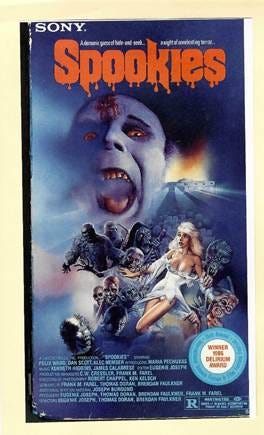
(Sony’s original DVD Cover)
Although we had the original, once-grand, now dilapidated old mansion to shoot in, the footage was originally shot in one season, and we were shooting at the opposite time of year. The foliage had changed entirely. But that's why you have art directors. SPOOKIES will not be the first movie to fake Fall in the Spring (or was it the other way around, I can’t remember now). Our young art directors went on to work on Saturday Night Live, having honed their magic-making-out-of-nothing skills.
Here's how it all worked: I would have my new actors open a door, and cut to an "old scene" occurring within the room. Or my characters would look in the window to witness previous cinematic efforts. Our new subplots, twists, and turns would weave through old ones. With careful storyboarding and matching lighting, we could make it look as if one set of actors were interacting with another set. Someone they had never seen. Then, I cut the old and new footage together to make it look like one 85-minute movie.
Many of the crew were people I had worked with on other productions. I couldn't have done any of this without my devoted cameramen, Bob Chappel and C.W. Cressler, both who went on to direct their own feature films. Many people who had previously been assistants in various departments were given a chance to be the heads of their department on SPOOKIES.
But SPOOKIES owes its cinematic aroma incredibilis to the masterful special effects of Arnold Garguiulo the Second. He lived at home with his parents, and while all was completely normal upstairs, downstairs in Arnold's basement dungeon were drawers of eyeballs, trays of teeth, shelves of blood, walls of masks, and every kind of horror you could hope to dream of.
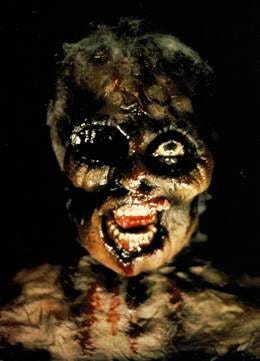
Some memorable monstrous making-of-moments were -- The SPOOKIES Audition:
Since we didn't have the budget to have a formal casting session, we saw beautiful and hopeful young ingénues right in the editing room (at the Film Center on 9th Avenue in New York City). For their screen test, these lovely ladies had to turn to the camera and let out a blood-curdling scream! If they passed that test, they were given a page of dialogue to read. We made quite a few enemies amongst the other editors down the hall -- as all day long, New York's finest femmes let out the most horrific wails I had ever heard.
Of course, since SPOOKIES was such a low-budget cinematic effort, we couldn't afford union actors, but no worries! These girls must have spent their senior year in high school practicing this sophisticated move of turning to the camera and letting out a sound that should require a license. They were good! But finally, we found one none of us could resist, the sweet Maria Pechukas, who would do anything for her first movie role.
Are you wondering what she would do? Her own stunts, of course! She hung from the crumbling rafters, had her wedding dress torn by zombies erupting from the earth, and ate our location food without complaint.
And then there was young Alec Nemser, the little boy we "buried alive." His screams were so realistic that neighbors called the cops while we were shooting, claiming we were truly murdering the young innocent. You'd think the 35-millimeter cameras and movie lights would've proved that (in the words of Mr. Alfred Hitchcock), "It's only a movie!" but alas, we were forced to take time out from our tight nine-day shooting schedule to answer some blistery questions from the local fuzz.
And just who were those Zombies clawing at the lovely Maria, ripping off everything and leaving her in the classic horror-movie state of white-slip undress? Well, there was Robert Epstein, the first boy I ever kissed. A handful of friends from acting class, a mother or two, and anyone willing to stay up all night for not much more than a stale tuna sandwich.
But hey, we were Creating Cinema. Or at least making a movie. Something that would play in a VCR. Truthfully, it did play in theaters, and I went to see it on opening day at a gritty Times Square Theater in New York City that could be its own horror film location. I slunk low in my chair as the afternoon audience of about 20 people laughed in all the right and wrong places and generally yelled all the important things at the screen, such as
"Don't go in there, you idiot!" It was music to my ears.
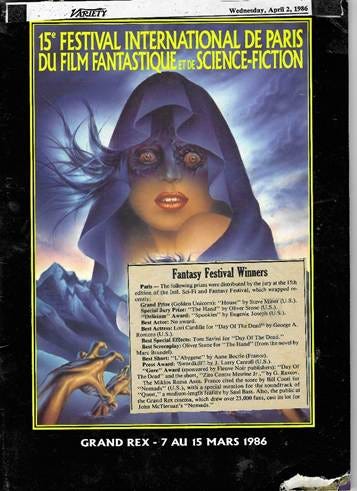
When SPOOKIES played at the Paris International Film Festival, next to "The Hand" by Oliver Stone and "Day of the Dead" by George Romero, I knew we might be poor relations, but we had arrived. Our mob of monsters had roared! I was interviewed by the French press and magazines like L'Ecran Fantastique (June 1986). The French are the greatest cinemaphiles! And there's nothing better for the wounded directorial ego than to be interviewed by them. They see many references to great classic films, which I was too embarrassed to admit I had never seen. These astute commentators always manage to find layers of meaning in your movies that you never dared to imagine.
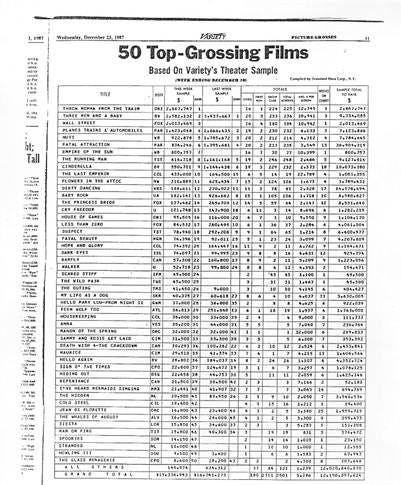
Despite its tumultuous start, SPOOKIES found a devoted following of cult aficionados. Even across the pond in France, where they truly appreciate cult movies. Of course, film critics weren't exactly kind. But landing on Variety's Top 50 List on December 23, 1987, was a delightful vindication!
And that's just a little bit of SPOOKY TRUE history for all the SPOOKIES fans! A little film that defied the odds, scared up a storm, and left a legacy that still haunts me to this day.
Genie Joseph
Director, Editor, Co-Writer of
SPOOKIES was originally distributed by SONY
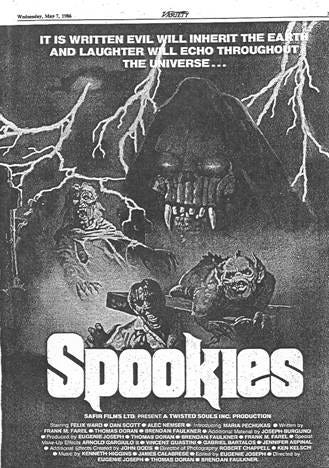
Re-released by Vinegar Syndrome
with commentary from the fired directors.
I was not invited to comment.
Did I tell you they hate me?
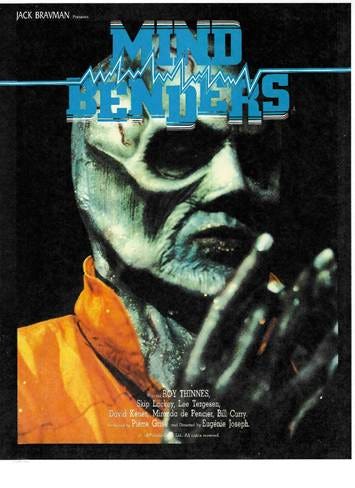
Vinegar Syndrome also released MindBenders, another film I co-wrote (with Skip Lackey) and directed. In the added sections at the end of MindBenders, you can see my interview, where I answer their questions about the true history of SPOOKIES.
I wish everyone with a cinematic dream the best of success, especially to those indie filmmakers working on a wing, a prayer, and a shoestring.
And thank you to those fans who reached out to tell me how much this movie means to them. That makes it all worthwhile.
Genie Joseph
(the final director of SPOOKIES)
Note: This story was written in April 2002.
Fascinating and engaging tale from your past life Genie. Very glad you're sharing part of your colorful history.
What an interesting Hollywood horror story ... and I'm not referring to the monsters. Your ability to pivot and salvage this product through grit and talent is really commendable!